.png)

.png)
12 Best Affiliate Marketing Software for SaaS Companies (2025)

The affiliate marketing industry is hitting $17 billion in 2025, with over 81% of brands now running affiliate programs. If you're a SaaS company still managing affiliates with spreadsheets and manual tracking, you're leaving money on the table.
Here's what happens without proper affiliate marketing software:
Tracking breaks, affiliates lose commission credit, you spend hours calculating recurring payments, and your best partners leave for competitors with better systems. In fact, 65% of retailers report that affiliate programs have increased their annual revenue by up to 20%. This only works when your tracking is reliable.
The problem?
Most affiliate platforms were built for e-commerce, not SaaS. They don't handle subscription billing, recurring commissions, or MRR attribution properly. You end up paying for enterprise software that doesn't fit your needs, or cheap tools where tracking fails and affiliates stop promoting you.
Industry experts project affiliate marketing will reach $27.78 billion by 2027, so setting up your affiliate system properly is now a must. The difference between software that works and software that breaks comes down to tracking accuracy and how well it handles SaaS billing.
We've reviewed 12 affiliate marketing software platforms built for SaaS companies, covering everything from bootstrap-friendly options to enterprise solutions.
Let's find what works for you.
Why You Need Affiliate Marketing Software
Managing an affiliate program manually works when you have 3 affiliates. It falls apart at 30.
Here's what breaks first: tracking. You're using UTM parameters and hoping people don't switch from mobile to desktop before signing up. When conversions don't attribute correctly, affiliates stop promoting you.
Then there's recurring commissions. Your top affiliate referred a customer who upgraded from $49/month to $199/month. Does the affiliate earn commission on the upgrade? What about downgrades? You're calculating this in spreadsheets instead of running your business.
Payouts eat up hours every month. Manual PayPal payments, tracking who got paid, collecting tax forms, generating invoices. One mistake and you're dealing with angry affiliates.
Without fraud detection, you're paying commissions on self-referrals and fake signups. And scaling to 100+ affiliates? You need a full team just to manage it.
Affiliate program management software fixes this. Accurate tracking, automated recurring billing, bulk payouts, fraud detection, and unlimited scale without hiring more people.
The question isn't whether you need it. It's which one fits your business.
Quick Comparison: 12 Best Affiliate Marketing Software
These are some of the best affiliate software options range from AI-powered solutions to enterprise-grade platforms.
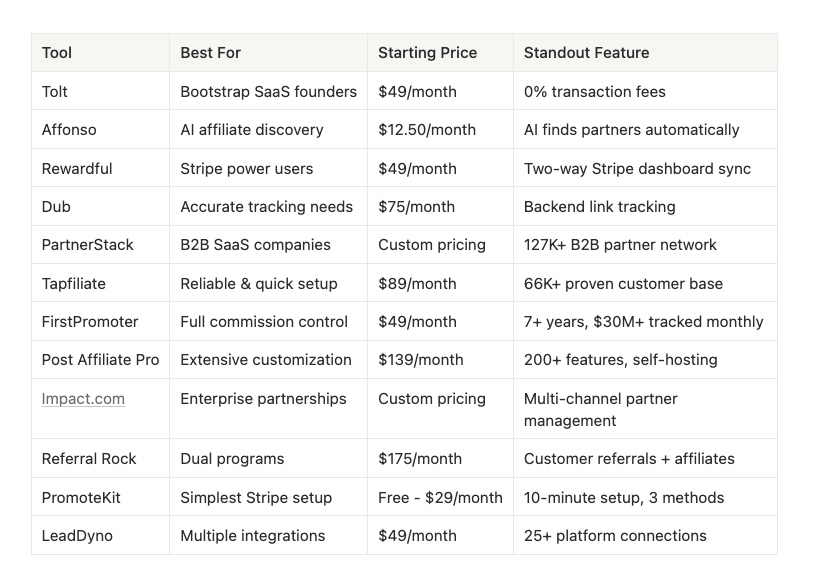
Let's examine each affiliate marketing solution in detail.
1. Tolt
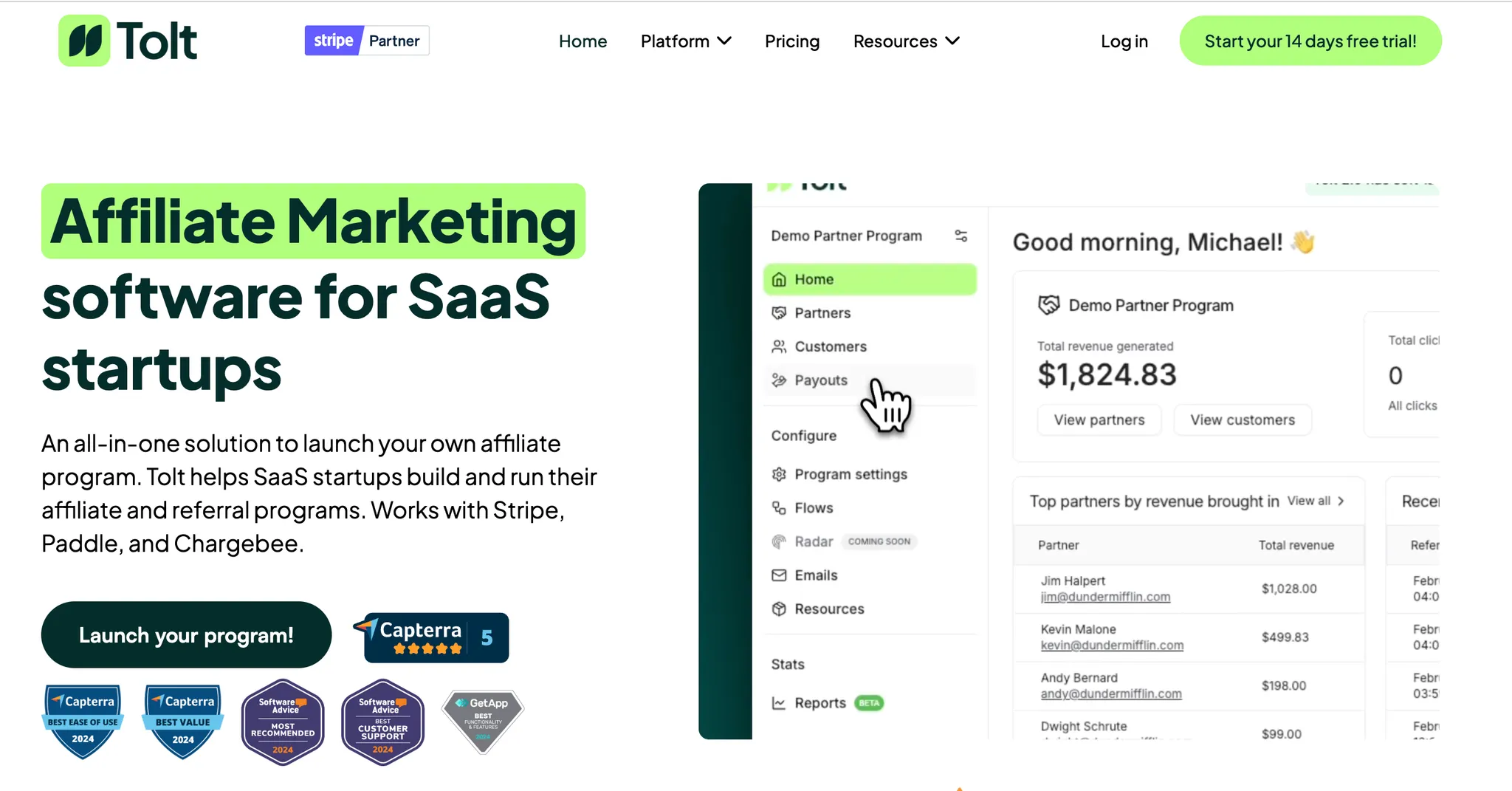
Best for: Bootstrap SaaS founders who need enterprise features without enterprise pricing
Tolt is the only affiliate platform charging 0% transaction fees. While competitors take 5-9% cuts of your affiliate revenue, Tolt charges a flat monthly fee. At scale, this difference is massive. If your affiliates generate $50K/month, you're saving $2,500-$4,500 monthly compared to platforms like Impact or Tapfiliate.
Built specifically for SaaS startups, it handles everything enterprise platforms charge thousands for. White-label branding with custom domains, automated global payouts in multiple currencies, and built-in tax compliance that collects W-9/W-8 forms and files 1099s automatically.
The setup is genuinely simple. Connect Stripe, Paddle, or Chargebee in 15 minutes and you're live. It tracks recurring commissions automatically, handles subscription lifecycle events (upgrades, downgrades, cancellations, refunds) without manual work, and processes affiliate payouts through PayPal, Wise, crypto, or wire transfers.
The platform has a perfect 5.0/5.0 rating on Capterra.
Key Features:
- 0% transaction fees across all plans
- Supports Stripe, Paddle, and Chargebee integrations
- Full white-label branding with custom domain (affiliates.yourdomain.com)
- Automated global payouts (PayPal, Wise, crypto, wire transfers)
- Built-in tax compliance (W-9/W-8 collection and 1099 filing)
- Recurring commission tracking for SaaS subscriptions
- Double-sided rewards (coupons for affiliates and customers)
- Custom commission rates per affiliate
Pros:
- Only platform with zero commission on affiliate revenue
- Setup takes under 15 minutes
- Beautiful white-label interface
- Supports three major payment processors
Cons:
- Auto payouts only available on Growth+ plans ($99/month)
- 2% processing fee on automated payouts
Pricing:
- Basic ($49/month up to $10K affiliate revenue)
- Growth ($99/month up to $20K)
- Pro ($199/month up to $50K)
- Enterprise (custom for $50K+)
All plans include a 14-day free trial with no credit card required.
2. Affonso
.webp)
Best for: Finding affiliates fast with AI-powered discovery
Most affiliate software makes you do the hard work of finding partners. Affonso flips this. Its AI Discovery Agent automatically identifies relevant creators and potential affiliates for your SaaS product, saving hours of manual outreach.
This matters because recruiting affiliates is where most programs fail. You launch the software, set up tracking, then realize you have nobody to promote you. Affonso solves this from day one.
For SaaS companies, it handles the messy parts: recurring commissions, refund adjustments, and multi-currency payouts. Built-in fraud detection catches self-referrals automatically.
Key Features:
- AI discovers and suggests potential affiliate partners
- Integrates with Stripe, Paddle, Polar, and other SaaS processors
- Automated fraud protection and self-referral blocking
- Handles refunds and subscription changes automatically
- Branded portal with customizable onboarding
Pros:
- Cheapest option at $12.50/month
- AI discovery eliminates cold outreach
- Setup under 30 minutes
Cons:
- Auto payouts require Growth plan ($29/month)
- White-label branding only on Elite tier
Pricing:
- Launch ($12.50/month)
- Growth ($29/month)
- Elite ($79/month)
- 14-day free trial available.
3. Rewardful
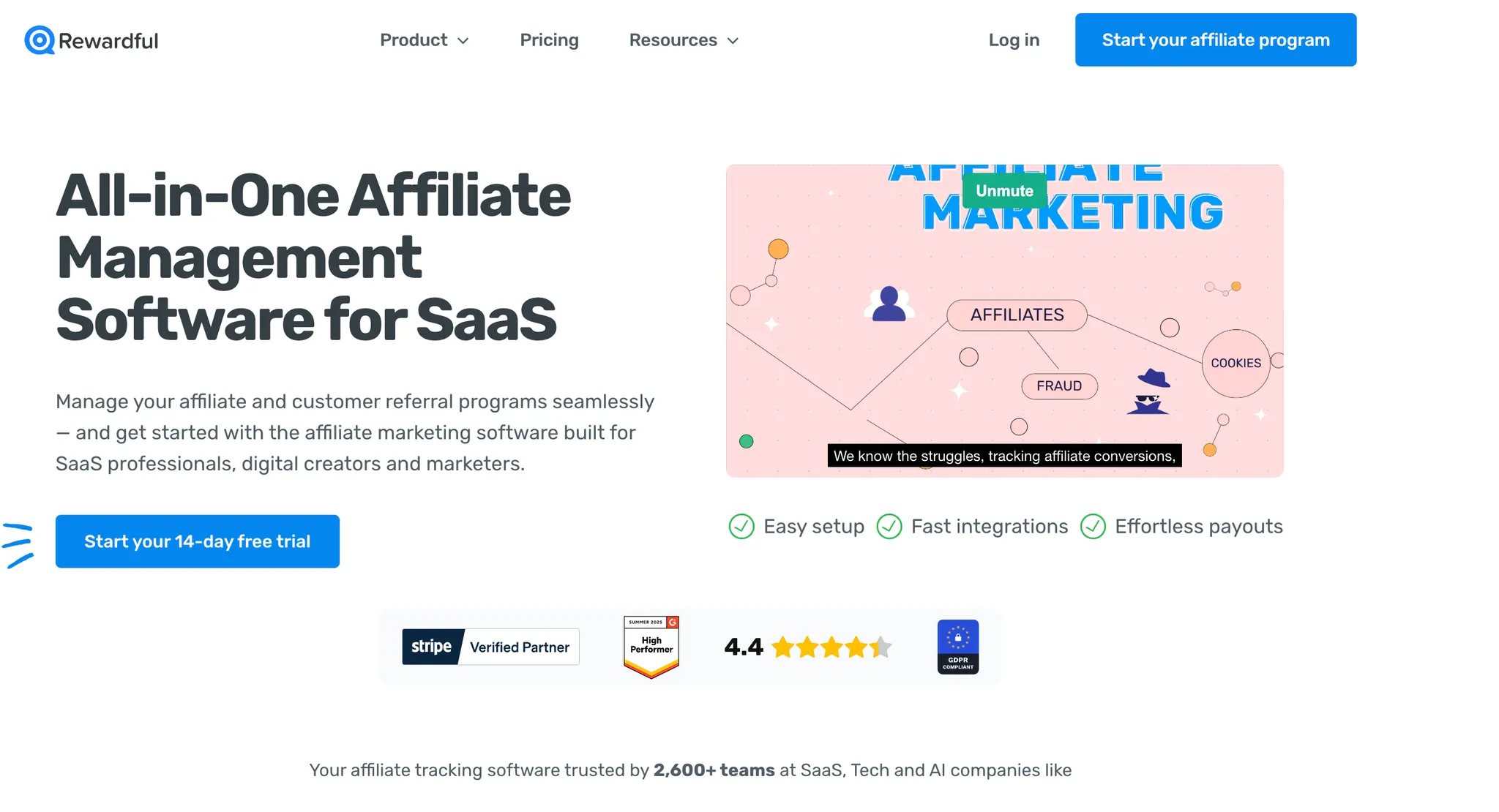
Best for: Stripe users who want the deepest integration available
Rewardful is the go-to for Stripe-based SaaS companies. The two-way sync means you see affiliate data directly in your Stripe dashboard. No switching between platforms. Everything lives where you already work.
Setup takes under 15 minutes. Connect Stripe, add two scripts, and you're tracking affiliates. It handles SaaS complexity automatically: trial conversions, upgrades, downgrades, refunds, cancellations. Commissions adjust without manual work.
The new coupon code tracking solves attribution when influencers share discount codes instead of links. Over 2,600+ companies use it.
Key Features:
- Two-way Stripe sync (manage affiliates inside Stripe)
- Coupon code tracking for influencer campaigns
- Automatic lifecycle tracking for subscriptions
- PayPal and Wise mass payouts
- Self-referral fraud detection
Pros:
- Deepest Stripe integration available
- Setup under 15 minutes
- Used by 2,600+ teams
Cons:
- Limited to Stripe and Paddle only
- Custom domain only on Growth plan
Pricing:
- Starter ($49/month)
- Growth ($99/month)
- Enterprise ($149/month)
- 14-day free trial available.
4. Dub
Best for: Companies that need the most accurate tracking possible
Most affiliate platforms use frontend JavaScript tracking that breaks when users switch devices or block cookies. Dub uses backend link tracking where the referral code is baked into the URL itself. Tracking happens server-side before JavaScript even loads.
This means no cookie loss, no ad blocker issues, and no attribution gaps when someone clicks on mobile but converts on desktop. It's the most reliable tracking method available.
Dub tracks tens of millions of conversion events monthly and processes $500K+ in partner payouts. Companies like Framer, Tella, and Privy use it. The platform is link management first, affiliate tracking second, so you get branded short links plus referral management in one tool.
Key Features:
- Backend link tracking (most accurate method)
- Branded short links (yourdomain.com/ xyz)
- AI landing page generator for partner signups
- Partner discovery based on similar programs
- Automated global payouts with tax compliance
Pros:
- Superior tracking accuracy
- No frontend dependencies
- Doubles as link management tool
Cons:
- More expensive at $75/month minimum
- 5% payout fees
Pricing:
- Business: $75/month (yearly) - $2,500/month payout limit, 5% fees
- Advanced: $250/month (yearly) - $15,000/month limit, 5% fees
- Enterprise: Custom pricing - unlimited payouts, 3% fees
5. PartnerStack
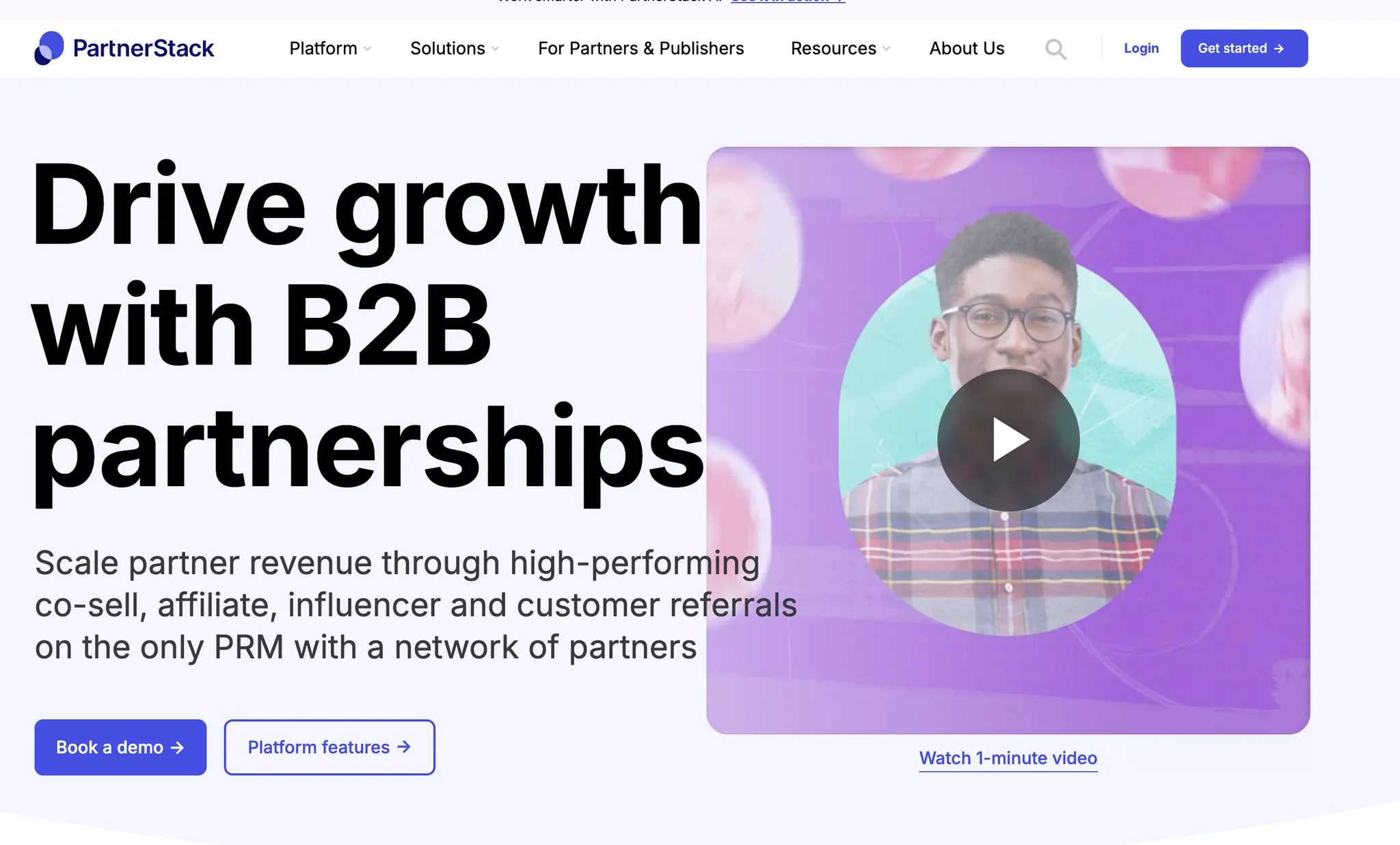
Best for: B2B SaaS companies building partner ecosystems
PartnerStack is built specifically for B2B SaaS, not adapted from e-commerce tools. PartnerStack handles long B2B sales cycles that other platforms miss. You reward partners for demos and trials, not just closed deals. The CRM sync connects to Salesforce and HubSpot so you track every partner-sourced lead from first touch to final conversion.
The marketplace connects you with 127,000+ active B2B partners. Over 600 companies including monday.com and Unbounce use it, driving $2.5B+ in sales through the network.
Key Features:
- PartnerStack AI for partner recruitment
- Event-based triggers (demos, trials, contracts)
- CRM-connected tracking (Salesforce, HubSpot)
- Recurring commissions for renewals
- Automated global payouts in 100+ currencies
Pros:
- Purpose-built for B2B SaaS
- Largest B2B partner marketplace
- Handles complex attribution
Cons:
- Custom pricing only
- Overkill for early-stage startups
Pricing:
- Custom pricing based on needs
- Request demo for quote
6. Tapfiliate
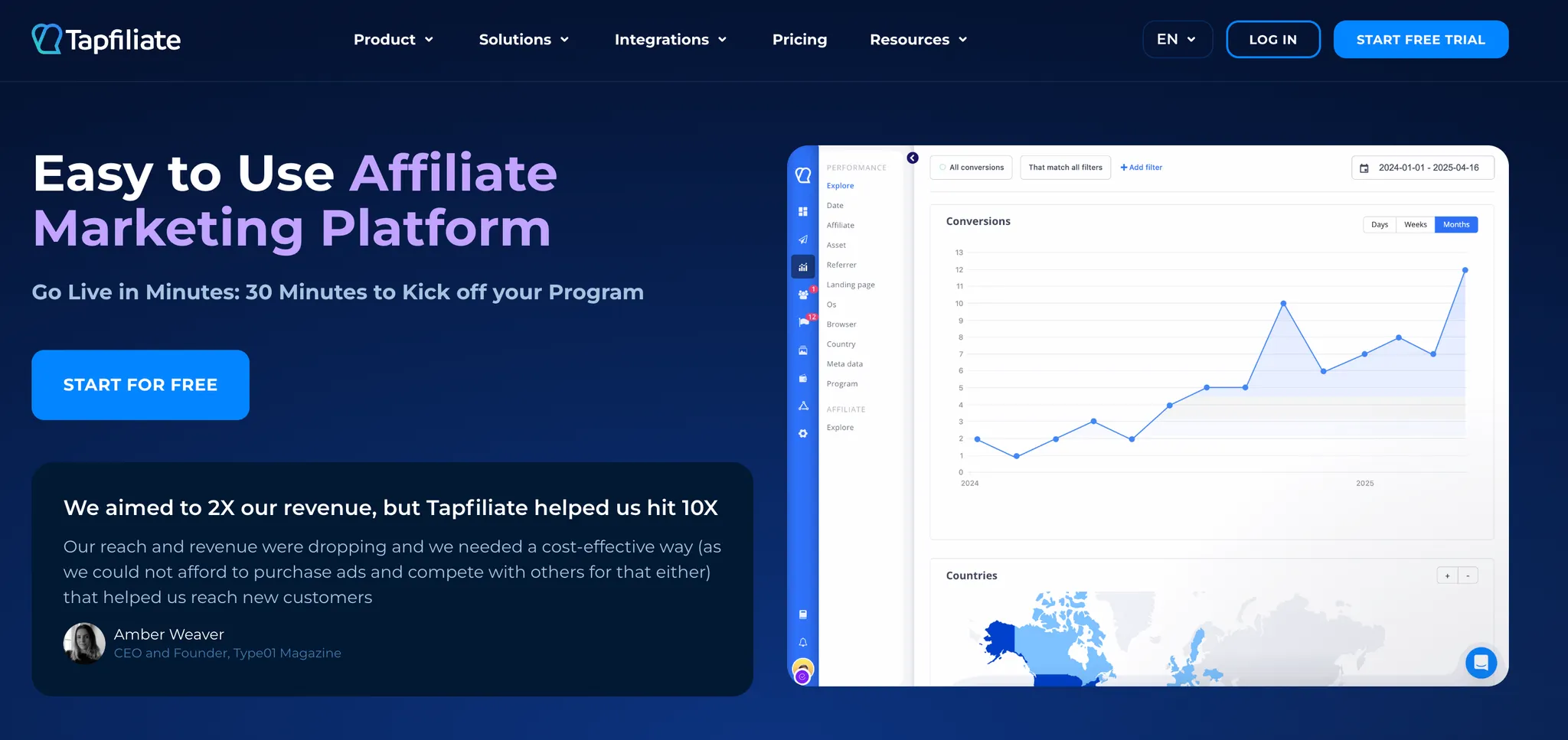
Best for: Companies that want reliable tracking with quick setup
Tapfiliate focuses on simplicity. Setup takes around 30 minutes with pre-built integrations for major platforms. With 66,000+ customers, it's a tested option that handles the basics well.
The platform includes multi-level marketing support if you need tiered commission structures. Multi-language support covers six languages for international expansion. The brand asset manager stores logos and promotional materials in one place for affiliates to access.
Automated recruitment tools help you find potential partners, and the bonus system rewards top performers when they hit certain milestones.
Key Features:
- 30+ pre-built integrations
- Multi-level marketing capabilities
- Brand asset manager for marketing materials
- Top affiliate bonus system
- Six-language support
- Automated recruitment tools
Pros:
- 66,000+ customer base proves stability
- Setup completed in 30 minutes
- Tracking reliability appreciated in customer reviews
Cons:
- Interface looks outdated compared to newer platforms
- Higher starting price at $89/month
Pricing:
- Launch: $89/month
- Scale: $149/month
- Enterprise: Custom pricing
- 7&14-day free trial
7. FirstPromoter
Best for: Teams wanting full control over affiliate commissions
FirstPromoter has been around for 7+ years, serving 2,000+ customers who track $30M+ in revenue monthly. That longevity matters in a space where platforms shut down and take your affiliate data with them.
The new Stripe Instant Flow lets you set up coupon code tracking in under 5 minutes without any developer help. Create Stripe coupons directly in FirstPromoter or let affiliates generate their own codes.
One-click auto-payouts handle everything. You pay a single invoice monthly and FirstPromoter distributes payments to all affiliates. The 18-point reporting system gives you visibility into campaign performance, traffic sources, and landing pages without digging through data.
Key Features:
- Stripe Instant Flow for 5-minute setup
- One-click automated payouts
- 18-point reporting system
- Multi-tiered commissions (up to 3 tiers)
- Customizable affiliate dashboard
- Built-in email marketing for affiliates
Pros:
- 7+ years of proven reliability
- Incredibly flexible commission structures
- Deep Stripe integration
Cons:
- Can feel complex for beginners
- Custom domain only on Business+ plans
Pricing:
- Starter: $49/month (up to $5K affiliate revenue)
- Business: $99/month (up to $15K)
- Enterprise: $149+/month
- 14-day free trial
8. Post Affiliate Pro
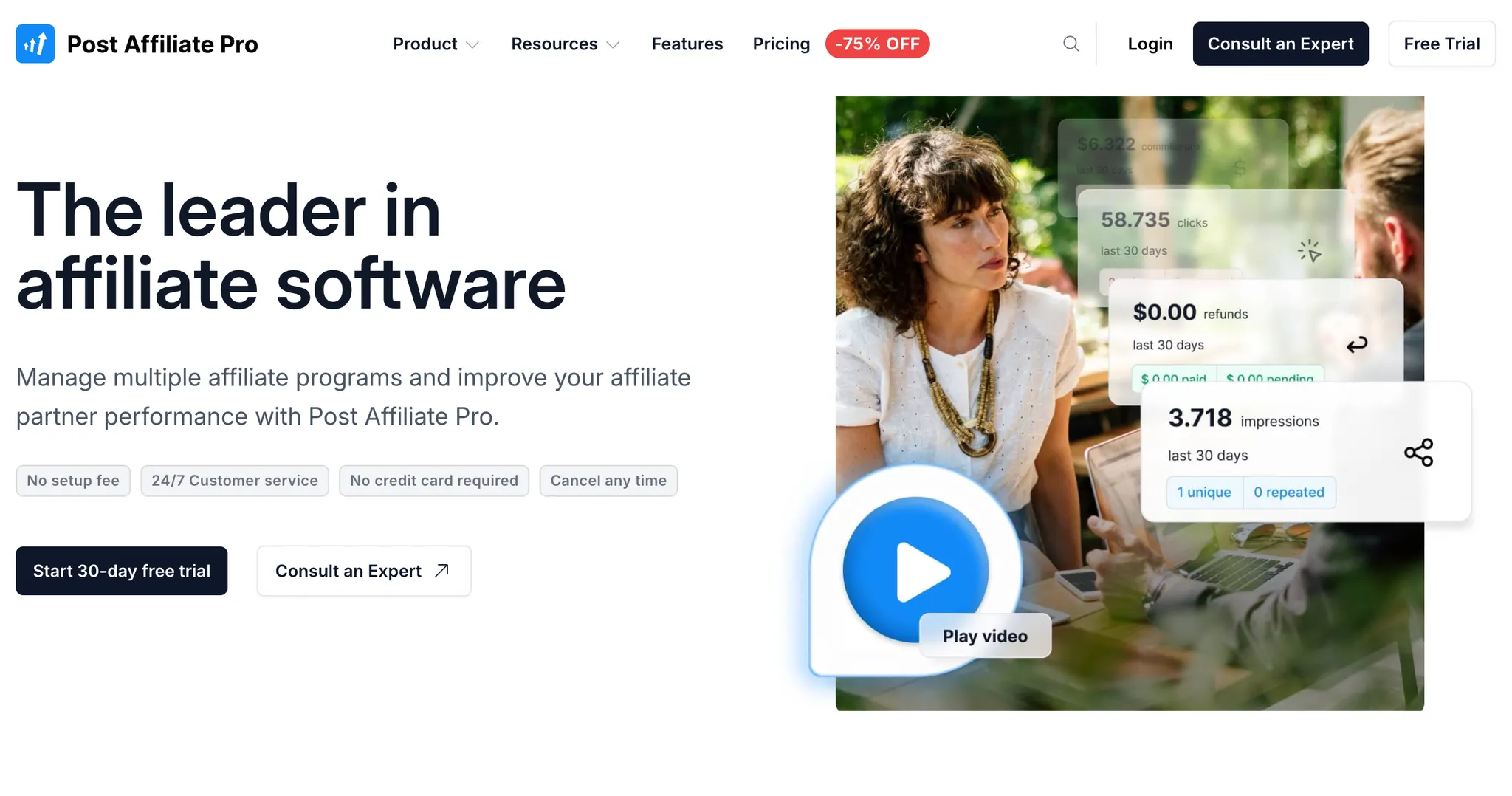
Best for: Companies that need extensive features and customization options
Post Affiliate Pro packs 200+ features into one platform. It's been around long enough to have built almost everything an affiliate program could need, though that comes with a learning curve.
The standout feature is self-hosting. You can run it on your own servers for complete data control, which matters for companies with strict compliance requirements. Site replication lets you create custom landing pages for each affiliate's audience.
Built-in marketing tools include email campaigns, banners, and promotional content management. Advanced payment integrations go beyond PayPal to include ReCharge, WorldPay, and Stripe for flexible payout options.
The platform handles complex setups like multi-level marketing, multiple commission structures, and detailed fraud detection.
Key Features:
- 200+ built-in features
- Self-hosted option for data control
- Site replication for custom affiliate landing pages
- Advanced fraud detection
- Multiple payment gateway integrations
- Built-in email marketing tools
Pros:
- Most feature-rich platform available
- Self-hosting option for compliance
- Handles complex affiliate structures
Cons:
- Steep learning curve due to feature overload
- Interface feels outdated
Pricing:
- Pro: $139/month
- Ultimate: $259/month
- Network: $649/month
- Free trial available
9. Impact
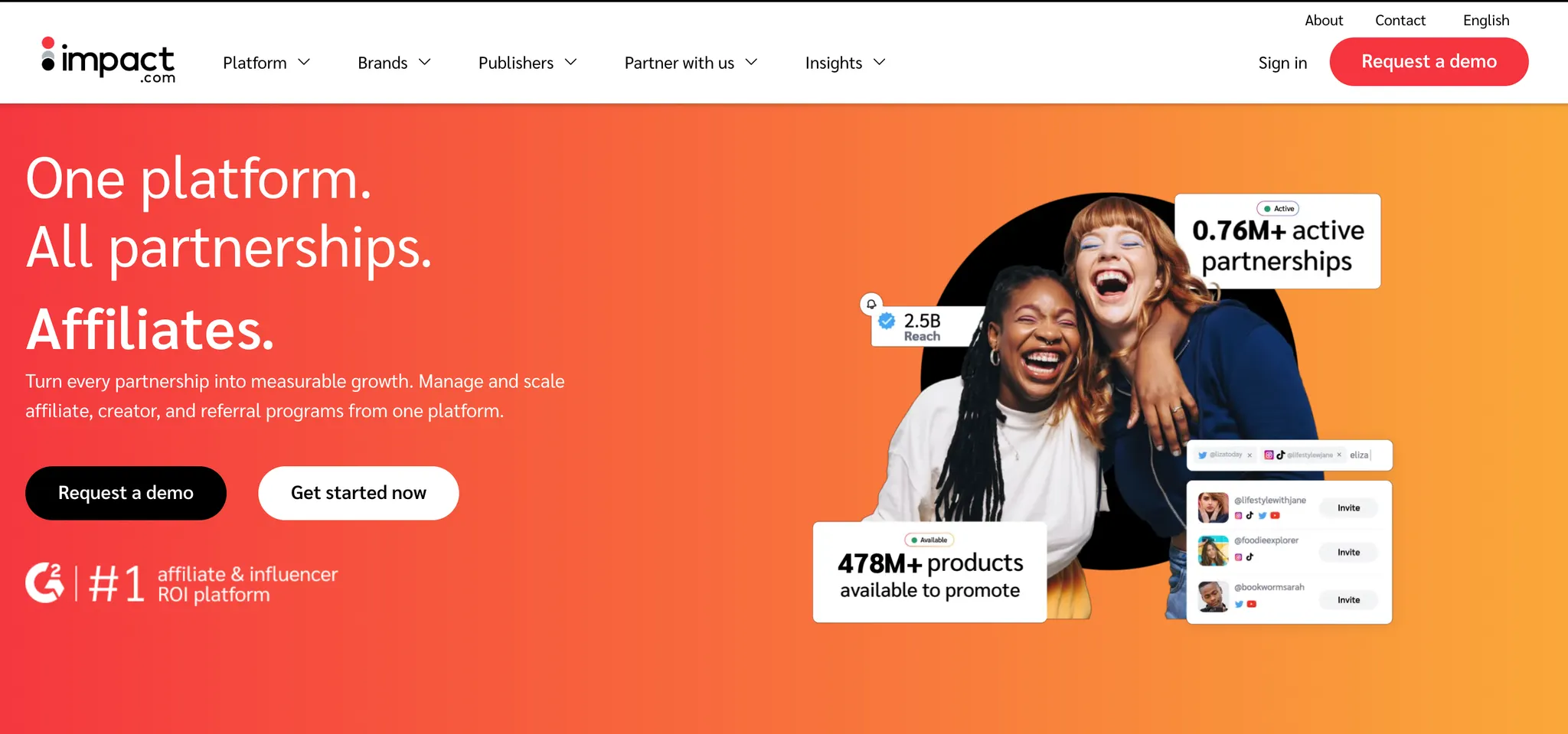
Best for: Enterprise companies managing complex partnership programs at scale
Impact is the partnership management platform for Fortune 500 companies. It handles affiliates, influencers, brand ambassadors, and B2B partners all in one system. This is enterprise-grade software with enterprise pricing to match.
The platform offers discovery and recruitment automation to find partners at scale. Contract management, tracking across devices, automated workflows, and fraud protection are all built-in. You get detailed analytics and optimization tools that go beyond basic affiliate tracking.
Most SaaS startups won't need this level of complexity. If you're managing millions in partner revenue across multiple channels with a dedicated partnerships team, Impact delivers the tools you need.
Key Features:
- Multi-channel partnership management (affiliates, influencers, advocates)
- Partner discovery and recruitment automation
- Cross-device tracking
- Fraud protection and monitoring
- Advanced analytics and optimization tools
- Automated workflows and engagement
Pros:
- Most comprehensive partnership platform
- Built for enterprise scale
- Handles multiple partner types in one system
Cons:
- Enterprise pricing (custom quotes only)
- Overkill for small to mid-sized companies
Pricing:
- Custom enterprise pricing
10. Referral Rock
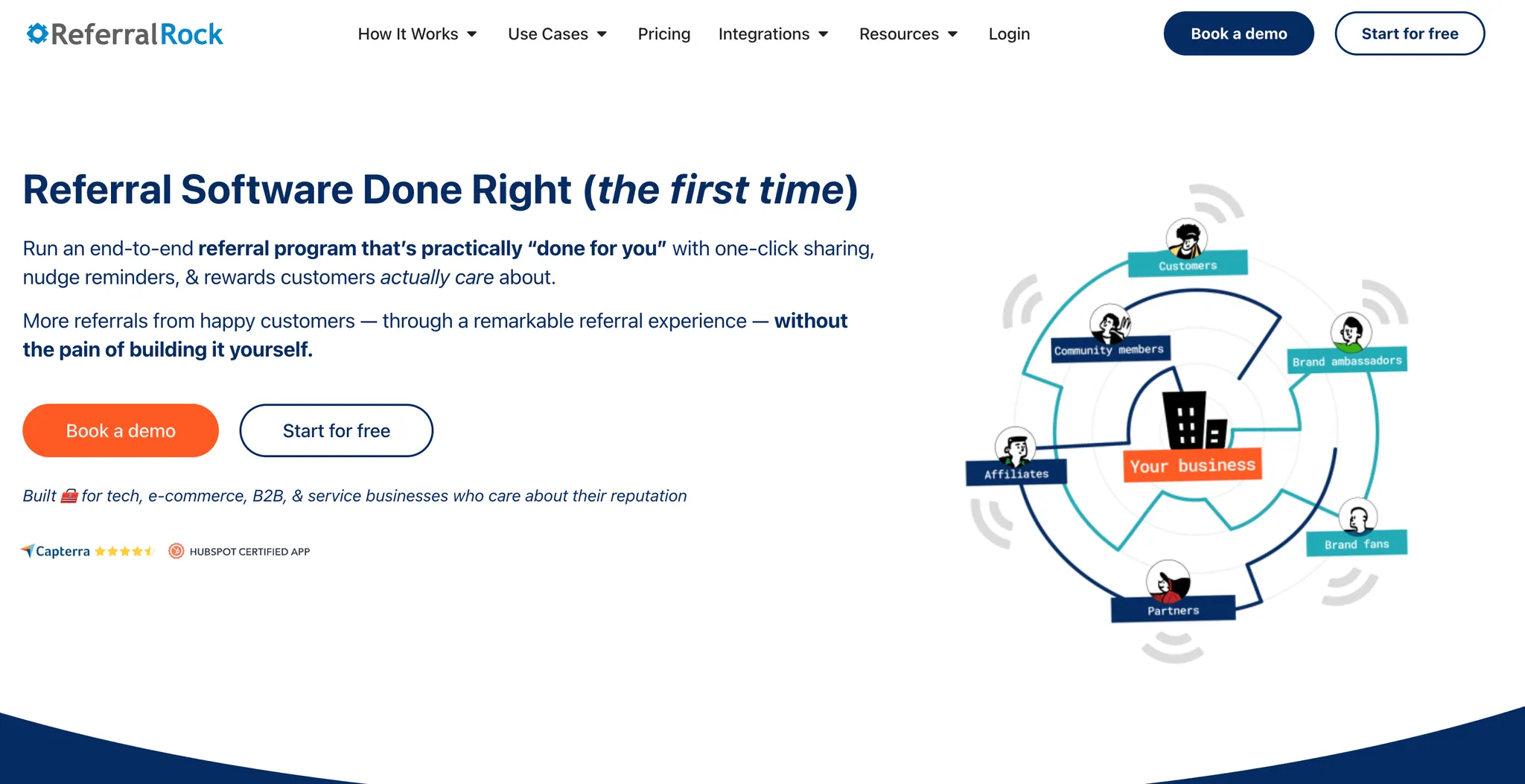
Best for: Companies wanting both customer referrals and affiliate programs
Referral Rock handles two programs in one platform: customer referrals and affiliate marketing. Most companies need both but end up using separate tools. This consolidates everything.
The dedicated referral portal makes it easy for customers and affiliates to share and track their referrals. Two-sided rewards let you incentivize both the referrer and the new customer. Milestone rewards encourage repeat sharing with bonuses at certain referral counts.
Integration with Shopify, HubSpot, Salesforce, and WooCommerce means referral data flows into your existing systems. The platform automates reminder emails and engagement campaigns to keep referrers active.
Key Features:
- Dual program support (customer referrals + affiliates)
- Dedicated branded referral portal
- Two-sided reward structures
- Milestone and tiered rewards
- Integrations with HubSpot, Salesforce, Shopify, WooCommerce
- Automated engagement and reminder campaigns
Pros:
- Handles both referral types in one platform
- Strong automation features
- Good for service-based and ecommerce businesses
Cons:
- Starting at $175/month (higher than alternatives)
- May be too broad if you only need affiliates
Pricing:
- Professional: Starting at $175/month
- Professional Plus: Starting at $350/month
- Free trial available
11. PromoteKit
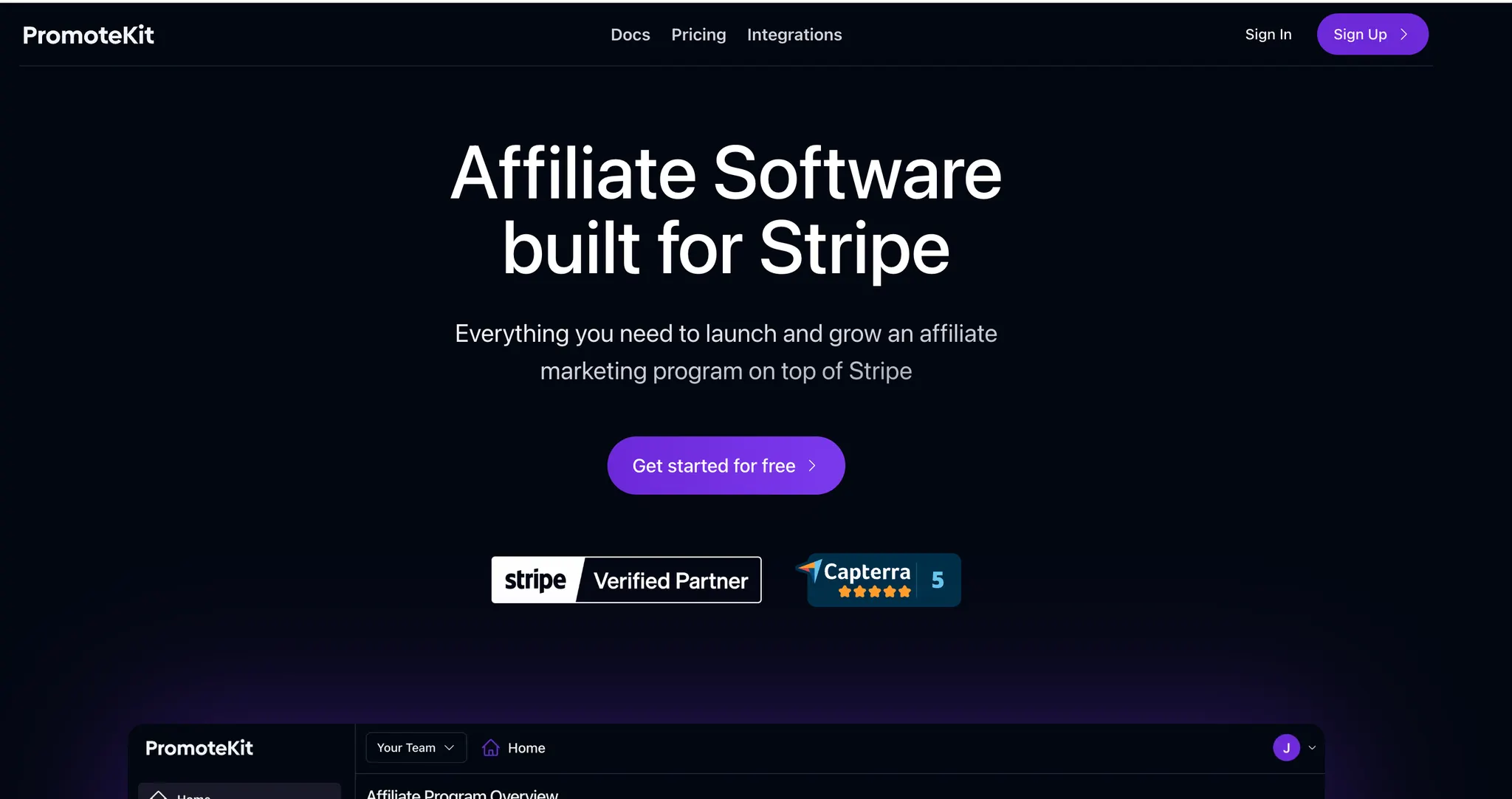
Best for: Stripe users who want the simplest setup possible
PromoteKit calls itself "software with a soul" and delivers on simplicity. Setup takes under 10 minutes with three options: no-code (auto-generated coupon codes), low-code (single script), or code-based (API integration). Choose what fits your technical skill level.
The two-way Stripe sync tracks trials, subscriptions, cancellations, and refunds automatically. Flexible commissions work for both recurring and one-time payments, with tier structures to reward top performers. The free plan lets you test with 3 referrals before committing.
Key Features:
- Three setup options (no-code, low-code, API)
- Two-way Stripe sync for complete lifecycle tracking
- Coupon code and link tracking
- Commission tiers for top affiliates
- Custom affiliate portal domain
- PayPal and Wise payouts
Pros:
- Genuinely simple 10-minute setup
- Free plan available for testing
- Affordable at $29/month
Cons:
- Stripe-only (no Paddle or Chargebee)
- Missing some advanced analytics features
Pricing:
- Free: Up to 3 referrals
- Pro: $29/month (up to $10K affiliate revenue)
- Enterprise: Custom pricing
12. LeadDyno
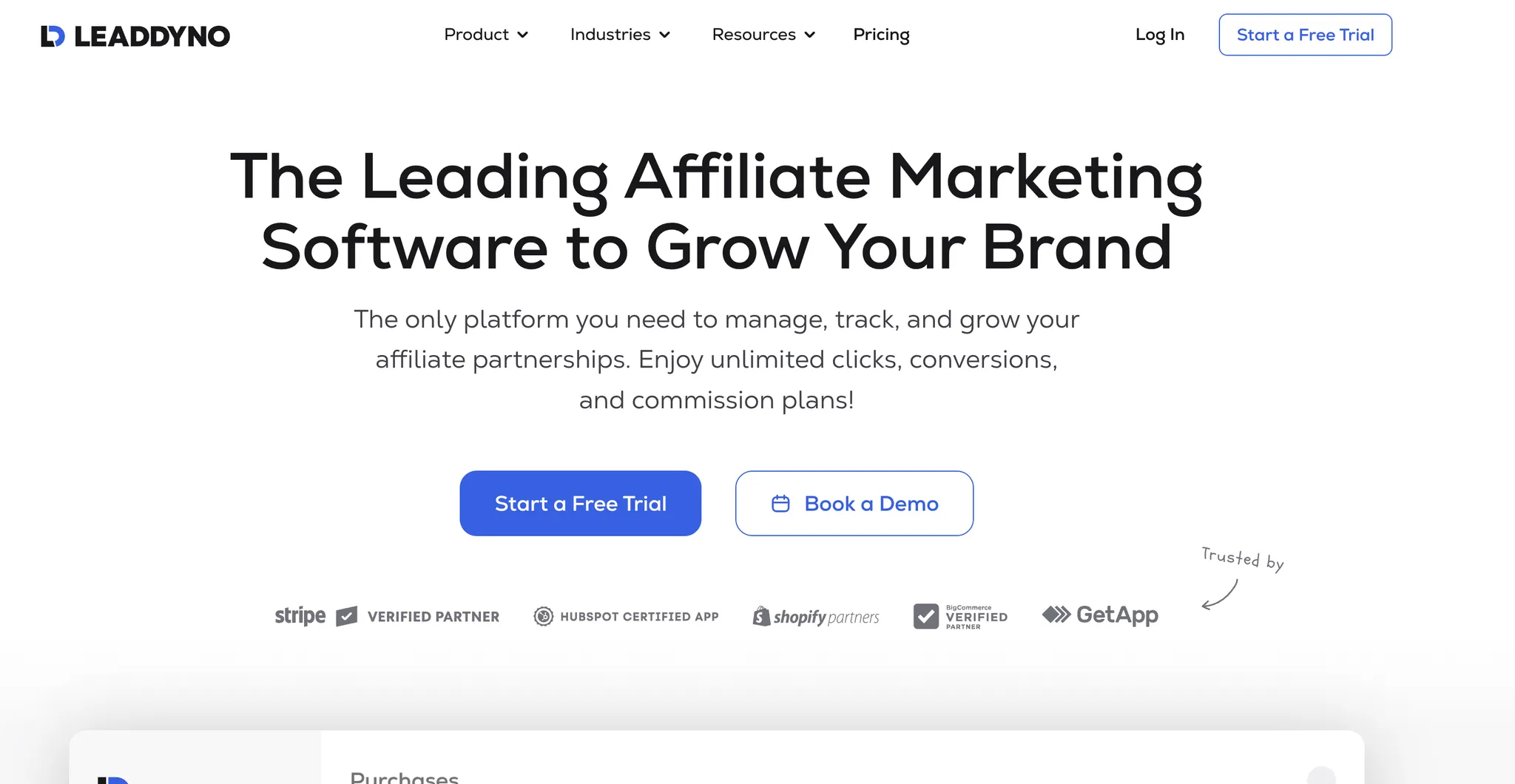
Best for: Versatile needs with 25+ platform integrations
LeadDyno stands out for its extensive integration ecosystem. With 25+ direct connections including Shopify, Stripe, BigCommerce, HubSpot, Chargebee, and WordPress, it works with almost any tech stack. Add Zapier access and you get even more flexibility.
The mobile app lets affiliates check performance anywhere, which keeps them engaged. Built-in email marketing tools mean you can communicate with affiliates without needing another platform. Automated onboarding reduces the manual work of adding new partners.
Unlimited commission structures let you create as many tiered, flat, or percentage-based plans as you need.
Key Features:
- 25+ direct platform integrations
- Mobile app for affiliate access
- Unlimited commission plan structures
- Automated affiliate onboarding
Pros:
- Most integration options available
- Unlimited clicks and conversions
- 30-day free trial
Cons:
- Interface feels outdated
- Dashboard navigation could be more intuitive
Pricing:
- Lite: $49/month
- Essential: $129/month
- Advanced: $349/month
- Unlimited: $749/month
- 30-day free trial available
How to Choose the Right Affiliate Marketing Software for SaaS
Selecting the right affiliate marketing software determines your program's success. Consider these key factors:
Payment Processor Compatibility: Verify native integration with your payment processor (Stripe, Paddle, or Chargebee) before evaluating other features. Custom API workarounds create ongoing tracking issues.
Pricing Structure: Calculate total costs including transaction fees, not just monthly subscriptions. Platforms charging 5-9% of affiliate revenue become expensive at scale. Flat-rate pricing models provide predictable costs as you grow.
Recurring Commission Handling: Ensure the platform automatically tracks subscription changes, upgrades, downgrades, cancellations, and refunds. SaaS requires software built for recurring revenue, not e-commerce one-time sales.
Tracking Method: Cookie-based tracking works well for desktop traffic. Mobile-heavy or social media audiences need backend tracking that survives device switching and ad blockers.
Partner Recruitment: Platforms with AI discovery or built-in marketplaces solve the cold-start problem if you lack existing affiliates. Otherwise, prioritize payout automation and reporting features.
Tax Compliance: Automated W-9/W-8 collection and 1099 filing become essential beyond 20-30 affiliates. Look for platforms with built-in compliance tools and global payout support.
Test two to three platforms with free trials using real conversion scenarios before committing.
Conclusion
Most SaaS companies overthink their affiliate software choice. The truth? You don't need every feature on day one.
If you're just starting out with fewer than 50 affiliates, pick software that handles the basics well: accurate tracking, automated payouts, and recurring commissions. Tolt does this at $49/month with 0% transaction fees, which matters more than you think.
When you generate $20K/month in affiliate revenue, that zero percent saves you $1,000-$1,800 monthly compared to platforms charging 5-9%.
Already have a list of potential partners but struggling to recruit them? Affonso's AI discovery at $12.50/month solves that specific problem without paying for enterprise features you won't use.
Running a complex B2B operation with long sales cycles? Then yes, PartnerStack's CRM integration and event-based triggers justify the higher cost.
Start with what you actually need today. Most platforms offer 14-30 day free trials. Test tracking with real conversions, process a sample payout, and see if your team actually uses the dashboard. The right choice becomes obvious after a week of real-world testing.
Try Tolt free for 14 days if you want reliable tracking without transaction fees eating your margins.








Grow on autopilot with an Affiliate Program!


