Want to turn your customers into a sales force? That's exactly what an affiliate program does.
Here's the quick version: An affiliate program pays partners (affiliates) a commission for every customer they refer to your business. They promote your product, you pay when they succeed.
The results speak for themselves:
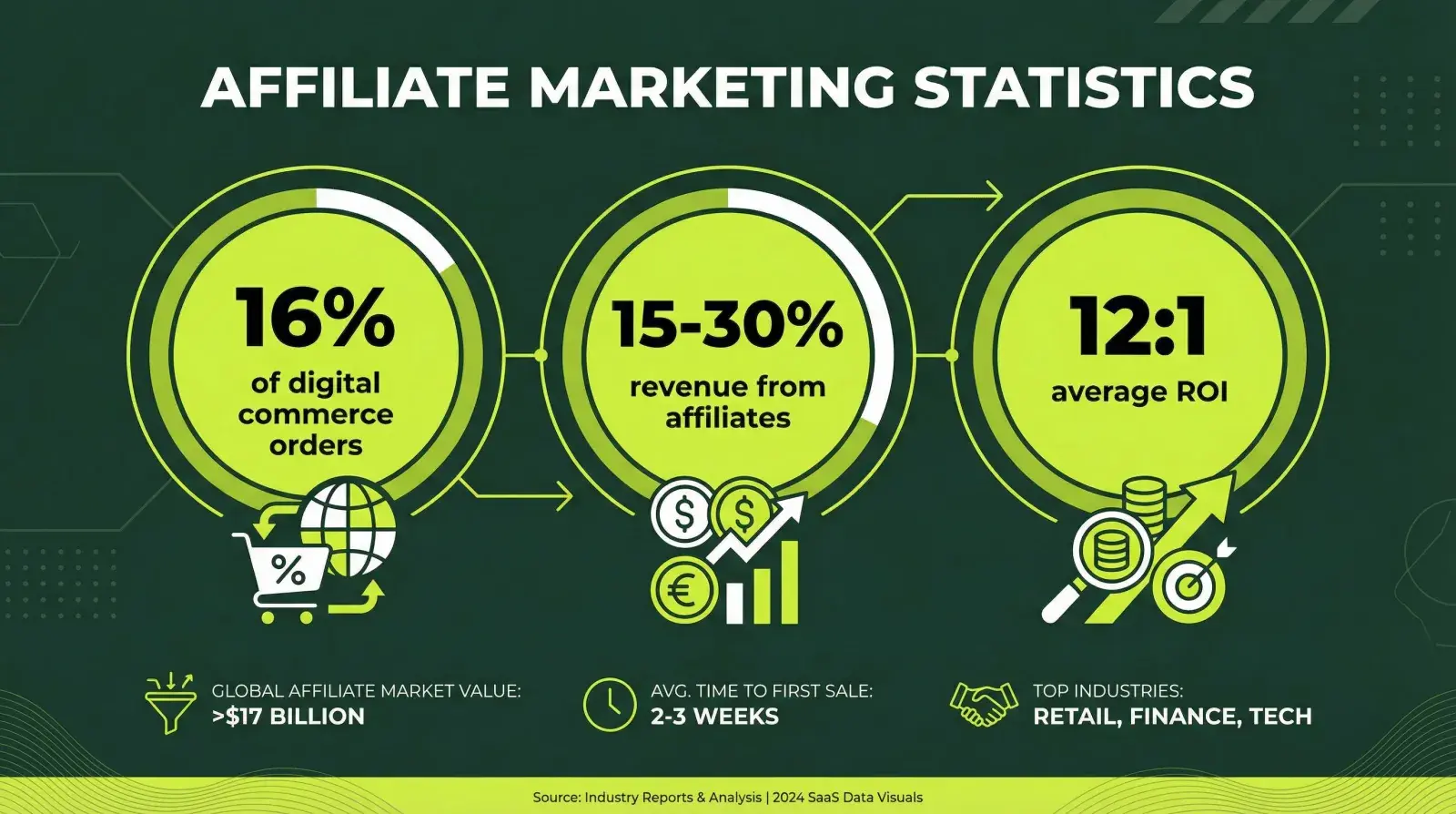
- 16% of all digital commerce orders come from affiliate marketing
- Companies with affiliate programs report 15-30% of revenue from partner referrals
- The average ROI is 12:1, $12 earned for every $1 spent
This guide walks you through creating an affiliate program from scratch. No fluff. Just the exact steps, decisions, and setup you need to launch.
Before you start: is your business ready?
Not every business should launch an affiliate program. Before you invest time and money, check these prerequisites:
1. Product-market fit
Do you have paying customers who stick around? Affiliates amplify what's already working. They can't fix a product with high churn or unclear value.
Green light: You have customers who pay, renew, and recommend you organically.
Red flag: You're still figuring out who your ideal customer is.
2. Unit economics that work
Can you afford to pay 20-30% commission and still be profitable? Calculate your customer acquisition cost (CAC) and lifetime value (LTV) first.
Example
- LTV: $1,200 (24 months × $50/month)
- Target commission: 25% of first month = $12.50
- Commission-to-LTV ratio: 1%
If your product is $5/month, a 20% commission is $1. That won't attract serious affiliates.
3. Time to support partners
Affiliate programs require ongoing work:
- Approving applications
- Answering partner questions
- Creating marketing materials
- Processing payouts
If you can't dedicate 3-5 hours/week initially, wait until you can.
All three boxes checked? Let's build your program.
Step 1 of 8: Define your affiliate program goals
What does success look like? Define specific, measurable goals before you start.
Primary metrics to track
- Revenue: Monthly affiliate revenue, Target: $10,000/month by month 6
- Customers: New customers from affiliates, Target: 50 customers/month
- Active partners: Affiliates generating sales, Target: 20 active affiliates
- ROI: Revenue ÷ program costs, Target: 10:1 or higher
Secondary metrics
- Conversion rate: Percentage of affiliate clicks that become customers
- Earnings per click (EPC): Average revenue per affiliate click
- Affiliate retention: Percentage of affiliates still active after 12 months
Write down your goals. Revisit them monthly. Adjust strategy based on what's working.
12,480
1,236
312
 Marcus Reid1,812 clicks2.9%
 Jonas Weber1,540 clicks2.7%
 Tom Brooks1,204 clicks2.4%
Step 2 of 8: Design your commission structure
Your commission structure is the engine of your program. It determines who joins, how hard they promote, and whether they stick around.
Get this wrong, and you'll attract the wrong affiliates (or none at all). Get it right, and you'll build a sustainable growth channel that compounds over time.
The key principle: align incentives. You want affiliates to refer customers who stick around, not just anyone with a credit card. Your commission structure should reward that behavior.
Commission models
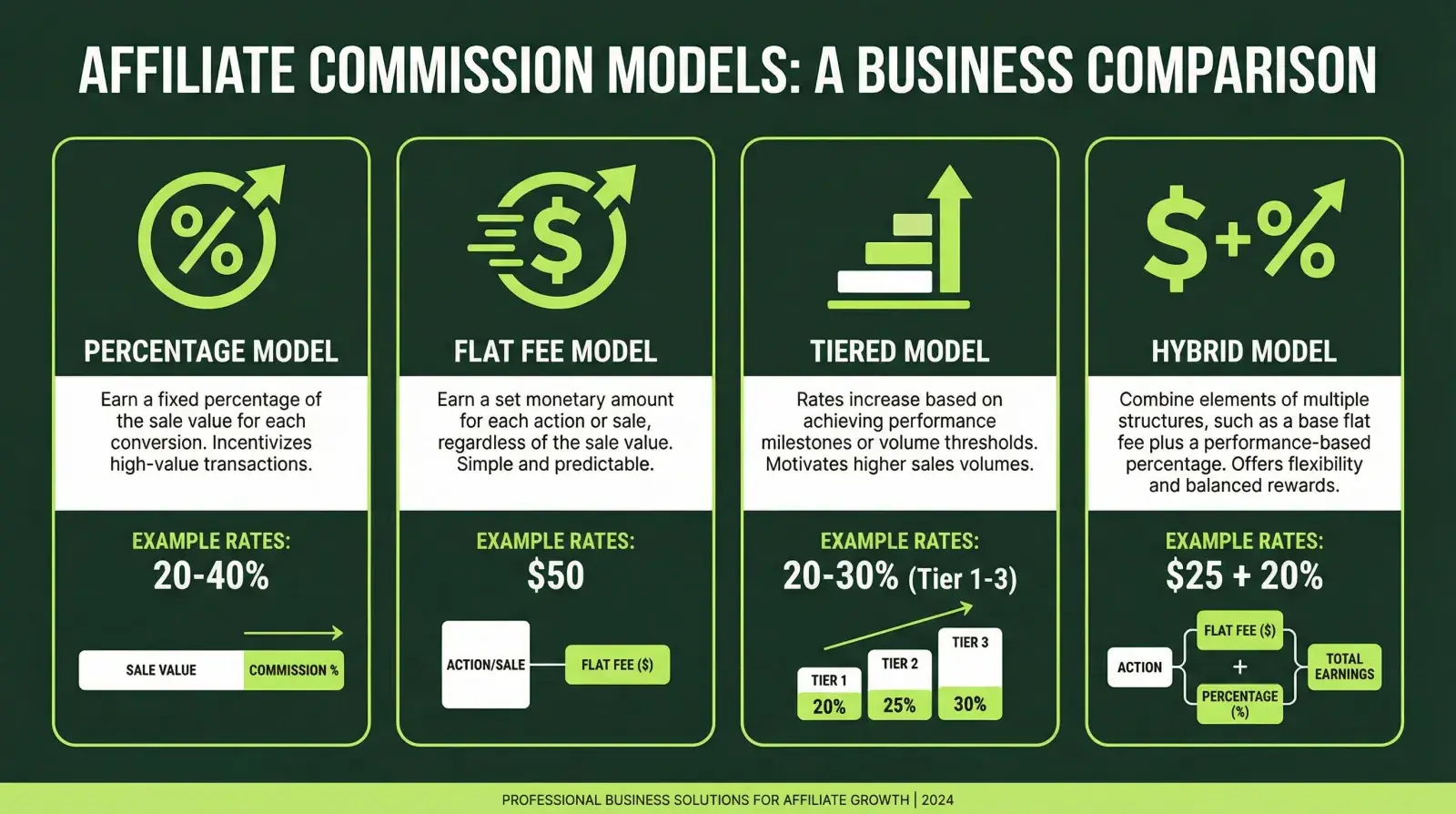
Percentage of Sale (Most Common) Pay a percentage of the customer's purchase or subscription.
- E-commerce: 5-20% one-time
- SaaS: 20-40% recurring
Flat Fee Per Sale Pay a fixed amount per customer acquired.
- Example: $50 per paid signup
Tiered Commissions Increase commission rates as affiliates hit volume thresholds.
- 0-10 sales/month: 20%
- 11-25 sales/month: 25%
- 26+ sales/month: 30%
Hybrid Models Combine flat fees with percentages.
- Example: $25 signup bonus + 20% recurring
SaaS-specific: recurring vs. one-time
For subscription businesses, you have a choice:
One-time commission
- Simpler to administer
- Lower total payout
- Less incentive for affiliates to refer quality customers
Recurring commission
- Aligns incentives (affiliates earn more when customers stay)
- Higher lifetime payouts attract better affiliates
- More complex tracking
What top companies pay
Skool went all in: 40% lifetime commissions. Their bet? Affiliates who earn forever will promote harder and longer.
HubSpot plays it safe: 30% for 12 months. Enough to attract serious affiliates without bleeding margin forever.
ClickFunnels copied Skool's playbook: 30% lifetime. Russell Brunson built an army of affiliates who never stop promoting.
ConvertKit found the middle ground: 30% for 24 months. Long enough to reward quality referrals, short enough to protect unit economics.
ActiveCampaign uses tiers: 20-30% based on performance. More sales = higher commission. Simple incentive alignment.
Starting point for SaaS: 25-30% recurring commission for 12 months. Adjust based on your unit economics and competitive landscape.
$1,515
a month in commissions after a year, from 51 customers still paying.
- First year
- $10,399
- Second year
- $18,186
- Month 24
- $1,515
Invoice paid
From your billing provider
Partner group is any of
30% recurring
for 12 monthsper invoice20% recurring
for 6 monthsper invoice+$89.70 to Marcus ReidGive 20% · Get 30%
Double-sided reward on partner coupons
Step 3 of 8: Set your program terms
Clear terms prevent disputes and protect both you and your affiliates.
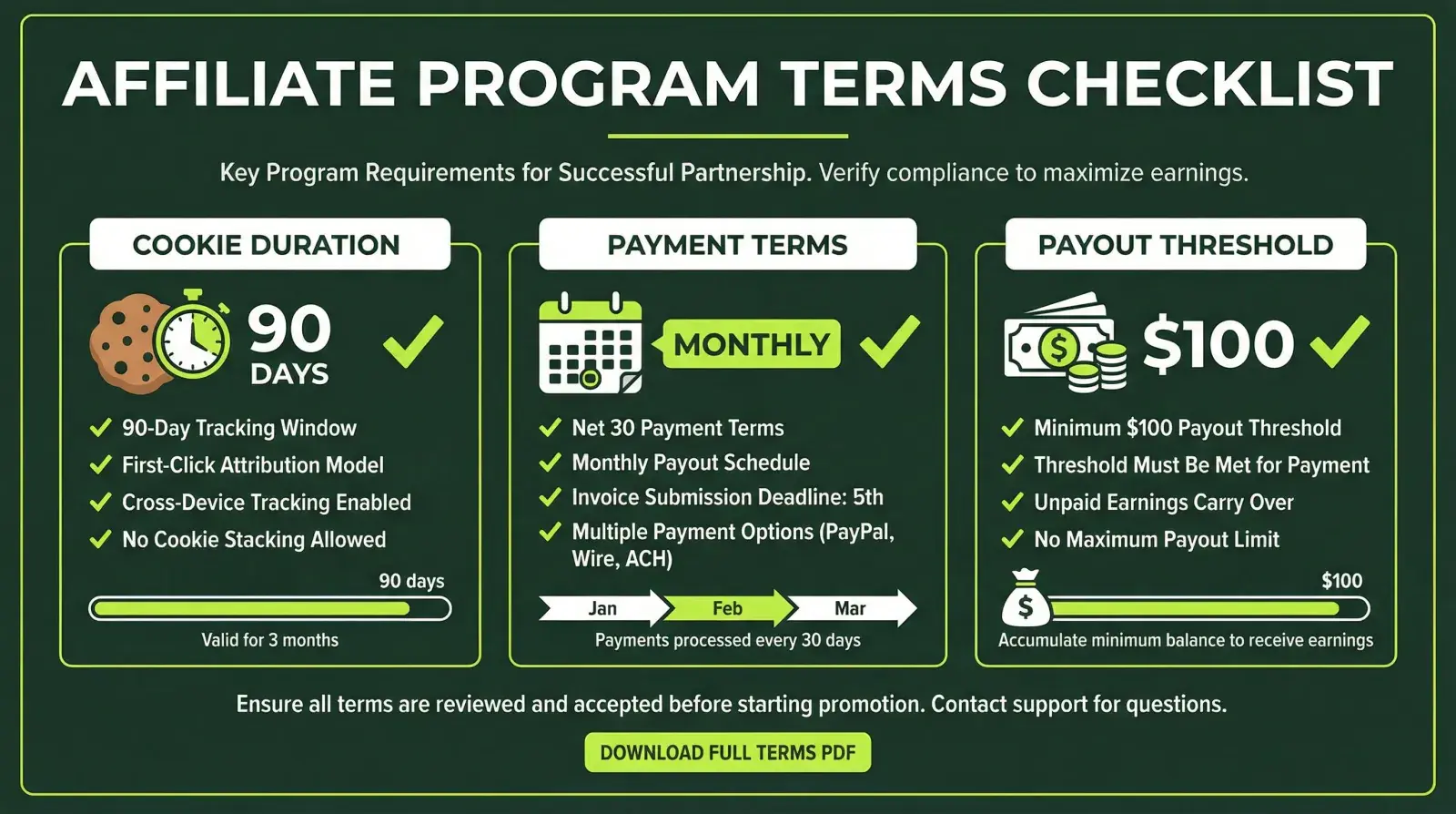
Cookie duration
How long after clicking an affiliate link does the affiliate get credit?
- E-commerce: 30 days is standard
- B2B SaaS: 60-180 days (longer sales cycles need longer cookies)
Fernly
ops@fernly.iocustomer since Sep 16Marcus ReidClicked a referral link
heyreach.io/?ref=marcusSigned up
ops@fernly.ioattributed to Marcus ReidStarted a trial
Pro plan14 daysPaid $299.00
invoice.paidcommission +$89.70Upgraded to Scale
Invoice $300.00commission +$90.00Partial refund $100.00
Commission auto-reversed−$30.00
Payment terms
Payout threshold: Minimum commission balance before payout (typically $50-100)
Payment schedule: Monthly payouts are standard. Net-30 or Net-60 after commission is earned.
Holdback period: Wait 30-60 days before paying commissions to cover refunds and chargebacks.
Payment methods: PayPal, Wise, Payoneer, or direct deposit. More options = happier affiliates.
Prohibited activities
Clearly define what affiliates cannot do:
- Brand bidding: Running ads on your company name
- Cookie stuffing: Artificially dropping cookies without real referrals
- Misleading claims: False promises about your product
- Spam: Unsolicited emails or messages
- Self-referrals: Signing up through their own link
Put these in writing. Enforce them consistently.
Step 4 of 8: Choose your affiliate software
You need software to track referrals, calculate commissions, and process payouts. Manual spreadsheets don't scale.
What to look for
Essential features
- Unique affiliate links and tracking
- Commission calculation and reporting
- Payout management
- Affiliate dashboard (for partners to see their stats)
- Integration with your payment processor
Nice-to-have features
- Branded affiliate portal
- Custom domain support
- Automated payouts
- Tiered commission structures
- Trial-to-paid tracking (for SaaS)
For SaaS companies: Tolt
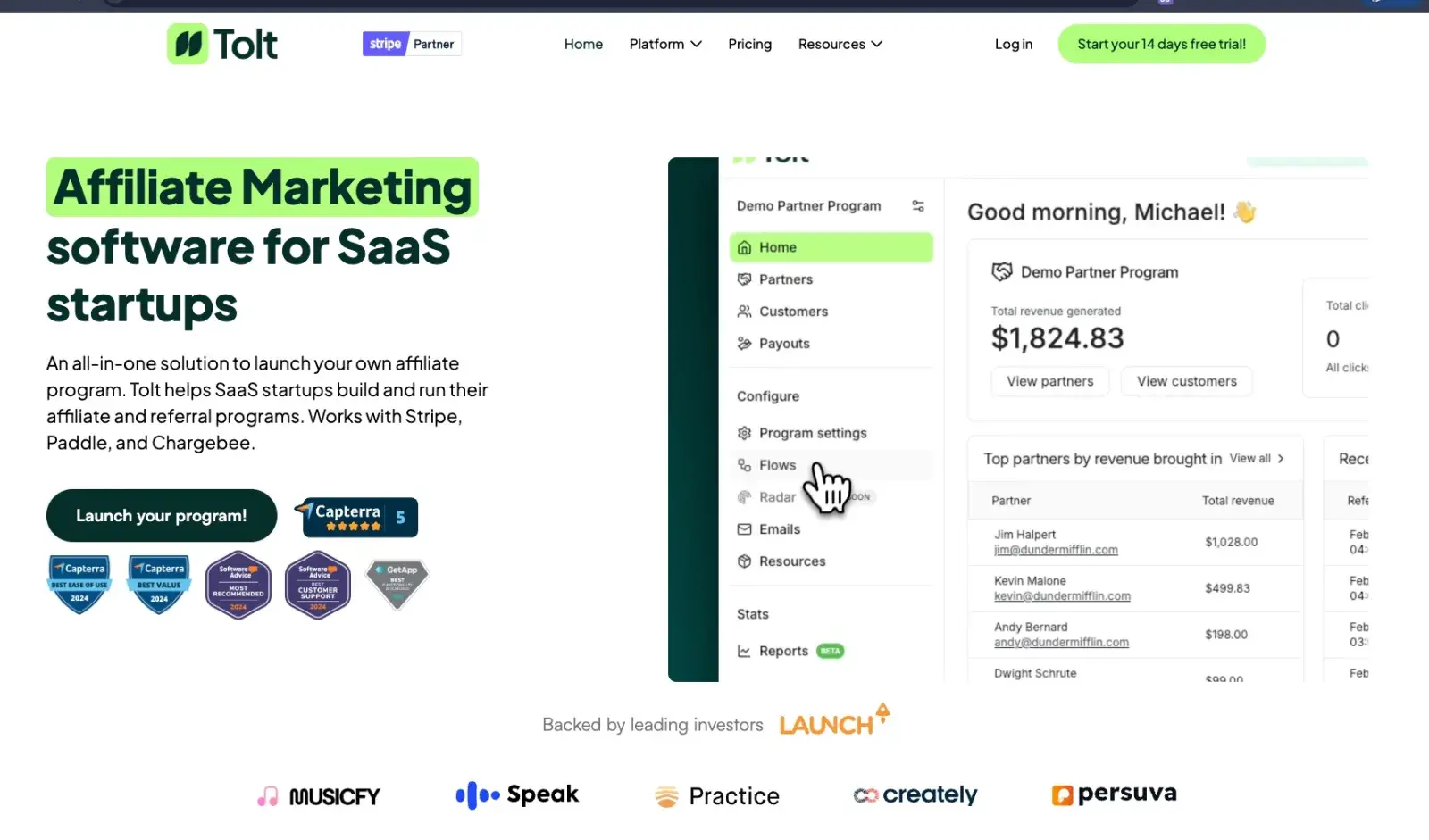
Tolt is an affiliate tracking software built specifically for SaaS startups. Key advantages:
Direct payment processor integration: Connect Stripe, Paddle, or Chargebee in minutes. Revenue tracking happens automatically, no manual imports.
Zero commission on payouts: Many affiliate platforms charge 9%+ on every payout. Tolt charges nothing.
Trial-to-paid tracking: Track the full funnel from click → trial → paid customer. Critical for SaaS with free trials.
Cross-subdomain tracking: Works when your app lives on app.yourdomain.com and marketing on www.yourdomain.com.
Branded affiliate portal: Give affiliates a professional experience at affiliates.yourdomain.com.
Setup in 15 minutes: Not days or weeks.
Step 5 of 8: Create affiliate resources
Affiliates promote more effectively when you make their job easy. Create an "Affiliate Starter Kit" with:
Essential marketing assets
Brand materials
- Logos in various formats (PNG, SVG)
- Brand colors and fonts
- Product screenshots and GIFs
Promotional content
- Email templates (introduction, follow-up, comparison)
- Social media posts (Twitter, LinkedIn, Facebook)
- Blog post templates or talking points
- Video scripts or talking points
Sales enablement
- One-page product overviews
- Case studies and testimonials
- Comparison guides (vs. competitors)
- FAQ answers
Affiliate dashboard requirements
Your affiliates need a portal where they can:
- Get their unique referral links
- Track clicks, signups, and commissions
- See payout history and pending earnings
- Access marketing materials
- Get program updates
Don't make affiliates email you for basic information. A self-service dashboard saves you time and keeps partners happy.
 Brand colorPraktika AffiliatesJoin nowJoin now
Step 6 of 8: Recruit your first affiliates
An empty affiliate program generates zero revenue. You need to proactively recruit partners.
The 80/20 rule of affiliate programs
Here's a truth about affiliate programs: 20% of your affiliates will drive 80% of your results. Most signups will never generate a single sale.
This is normal. Don't waste resources trying to activate every affiliate. Instead:
- Focus on identifying and nurturing your top performers
- Provide extra support and resources to high-potential affiliates
- Don't measure success by total signups, measure by active, revenue-generating affiliates
Where to find affiliates
Your existing customers Your happiest customers are your best affiliates. They already know your product, love it, and have credibility when recommending it.
Action: Email customers with high NPS scores or who've given testimonials. Invite them to your affiliate program.
Industry influencers and creators Bloggers, YouTubers, podcasters, and newsletter writers in your space have built audiences you want to reach.
Action: Make a list of 20-30 creators in your niche. Personalized outreach (not mass email) works best.
Complementary tool companies If you're a CRM, partner with email marketing tools. If you're project management, partner with time tracking apps.
Action: Look for tools your customers already use. Propose mutual affiliate relationships.
Review sites and comparison blogs Sites like G2, Capterra, and niche comparison blogs drive high-intent traffic.
Action: Reach out to sites that review your category. Offer affiliate relationships.
Outreach template
Subject Partnership opportunity: [Your Product] affiliate program
Hi [Name],
I’ve been following your work on [specific content they created]. Really enjoyed [specific detail that shows you actually read it].
We just launched an affiliate program for [Your Product] and I think your audience would be a great fit. Quick details:
– 30% recurring commission for 12 months
– 90-day cookie window
– Dedicated support and marketing materials
– [One unique selling point of your product]
Would you be interested in learning more?
[Your name]
Quality over quantity
10 active, engaged affiliates beat 100 dormant signups.
- Manually review every application
- Check their website/content before approving
- Prioritize affiliates whose audience matches your ideal customer
- Say no to affiliates who don't fit
Step 7 of 8: Launch and announce
Time to go live. Here's your launch checklist:
Launch announcement
On your website
- Dedicated affiliate program page
- Link in footer and/or navigation
Email announcement
- Send to existing customers
- Highlight commission structure and benefits
Social media
- Announce on all channels
- Pin the announcement for visibility
Direct outreach
- Continue recruiting target affiliates
- Personal follow-ups with warm leads
Founding affiliate perks
Consider offering extra incentives to early affiliates:
- Higher commission rate for the first 6 months
- Bonus for first 10 referrals
- Early access to new features
- Direct line to you for support
Early affiliates take a risk on an unproven program. Reward them for it.
Hi First name, Black Friday is our biggest week. From Nov 23 to Nov 30 every paid referral earns 40% instead of 30%.
Your link and coupon are ready in the portal, with fresh swipe copy and banners.
Commission boost
Nov 23 – Nov 30 · all groups
Channels
- Notification center
- Portal banner
- Chat bubble
Step 8 of 8: Monitor, optimize, repeat
Launching is just the beginning. Ongoing optimization makes the difference between a mediocre program and a growth engine.
Weekly review
- New affiliate signups
- Active vs. dormant affiliates
- Click and conversion volume
- Commission payouts processed
Monthly review
- Total affiliate revenue
- ROI calculation
- Top-performing affiliates
- Commission-to-LTV ratio
- Affiliate churn rate
Marcus ReidCreators$18,420+32%Jonas WeberCreators$12,960+8%Tom BrooksCreators$7,305−4%Marcus Reid$18,420+32%This month, against $13,955 in AugustOptimization levers
If signups are low
- Increase outreach volume
- Improve your affiliate page
- Raise commission rates
If conversions are low
- Review landing pages
- Provide better marketing materials
- Train affiliates on messaging
If affiliate retention is low
- Improve communication
- Increase commissions
- Add tiered rewards
- Recognize top performers publicly
If ROI is low
- Tighten affiliate vetting
- Adjust commission structure
- Focus on quality over quantity
Common mistakes to avoid
1. Launching without software
Spreadsheets break. Manual tracking causes disputes. Affiliates don't trust programs they can't verify. Invest in proper software from day one.
2. Commission too low
A 5% commission on a $20 product is $1. No serious affiliate will promote for $1. Competitive commissions attract competitive affiliates.
3. No marketing materials
"Here's your link, good luck" is not an affiliate program. Affiliates need assets, templates, and guidance to promote effectively.
4. Auto-approving everyone
Quality control matters. Bad affiliates damage your brand, attract wrong-fit customers, and increase fraud risk. Vet every application.
5. Ignoring your affiliates
Affiliates are partners, not passive income sources. Regular communication, updates, and recognition keep them engaged.
6. Short cookie windows
If your sales cycle is 30 days but your cookie expires at 7, you're stealing attribution from affiliates. Match cookie duration to actual buyer behavior.
7. No fraud prevention
Without proper safeguards, you'll eventually encounter:
- Self-referrals (affiliates signing up through their own link)
- Fake signups to hit commission thresholds
- Cookie stuffing and click fraud
Protect yourself with manual application review, holdback periods on payouts, and regular auditing of suspicious patterns.
8. Treating all affiliates the same
Your top performer generating $5,000/month deserves different treatment than a dormant affiliate who's never referred anyone. Create tiers, offer exclusive perks to top affiliates, and invest your time where it has the highest return.
Affiliate program success timeline
Setting realistic expectations helps you stay motivated during the building phase.
Months 1–2
Foundation
Launch the program, recruit 10–20 founding affiliates and see the first handful of referrals. Expected revenue: $0–500.
Months 3–4
Traction
50+ affiliates, 10–15 of them actively promoting; refine your materials on their feedback. Expected revenue: $500–2,000.
Months 5–6
Growth
100+ affiliates, 20–30 active, and the first top performers. Expected revenue: $2,000–5,000.
Months 7–12
Scale
Steady recruiting, close ties with your top 20%, and 10–20% of new revenue from the program. Expected revenue: $5,000–15,000+.
These numbers vary widely by industry, product, and commission structure. But the pattern is consistent: slow start, then compounding growth as affiliates build momentum.
Launch your affiliate program today
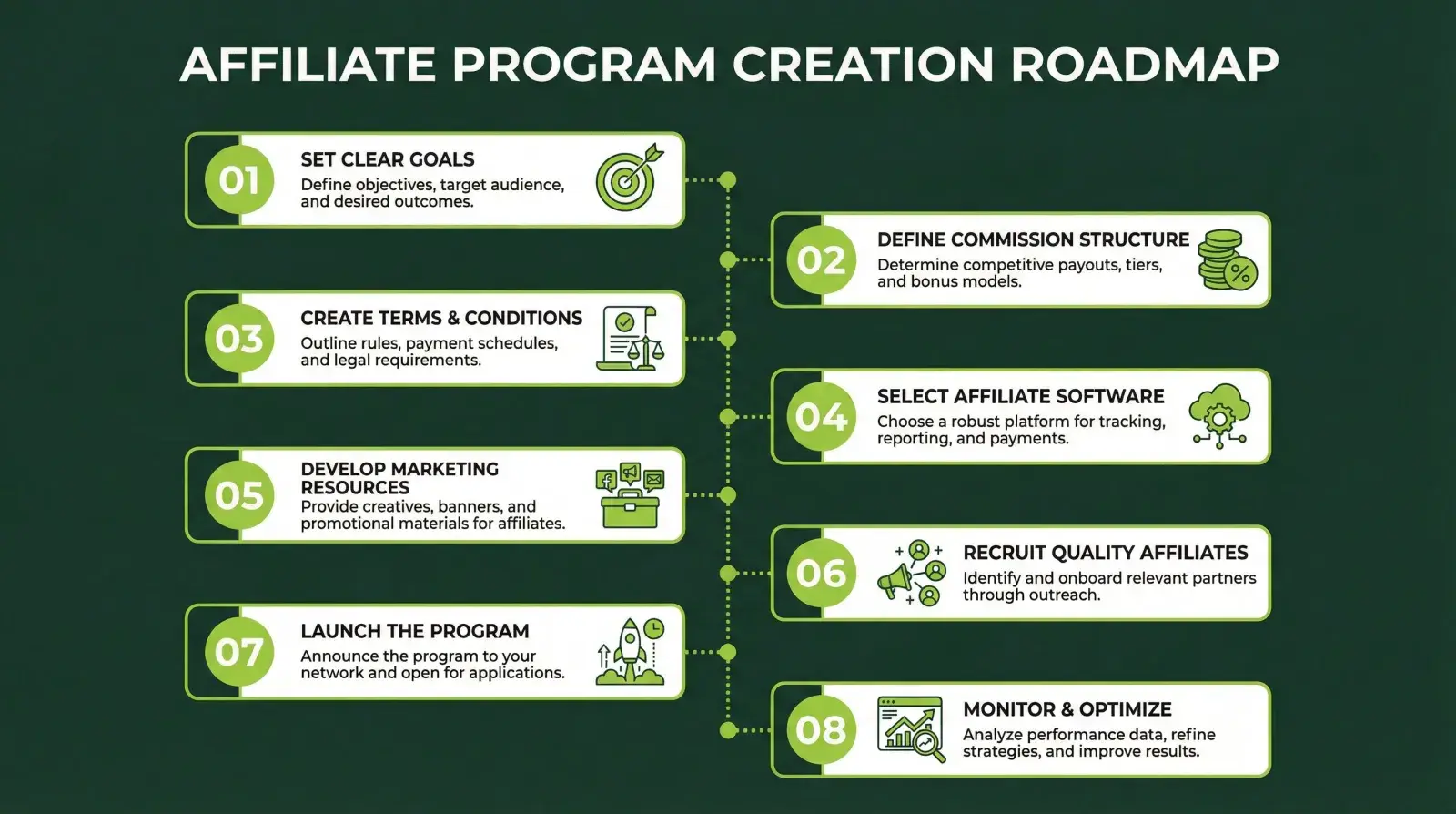
Creating an affiliate program isn't complicated. It's a series of decisions:
- Goals: What does success look like?
- Commission: How much will you pay?
- Terms: What are the rules?
- Software: How will you track?
- Resources: What will you provide?
- Recruitment: Who will you invite?
- Optimization: How will you improve?
The hardest part is starting. Pick your commission structure, choose your software, recruit your first 5 affiliates, and iterate from there.

Written by
Damjan, Growth at Tolt

 Capterra
